Global Variations in the Political and Social Economy of Care by Shahra Razavi Silke Staab
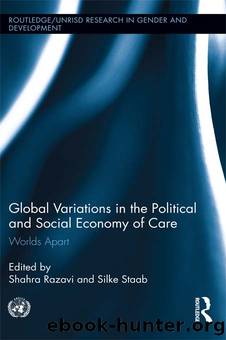
Author:Shahra Razavi, Silke Staab [Shahra Razavi, Silke Staab]
Language: eng
Format: epub
ISBN: 9780415754552
Barnesnoble:
Publisher: Taylor & Francis
Published: 2014-04-09T00:00:00+00:00
CONCLUSIONS
Through our analysis of care policy and practices, we have teased out five key features that define the Nicaraguan care regime. First, public services are lacking, and given Nicaraguansâ generally low capacity to commodify care, the family remains central to care arrangements.
Second, data on time-use shows that within households and families the gender division of unpaid care labour is quite pronounced. Men hardly participate in domestic work, although they do slightly better when it comes to looking after small children. Even though Nicaragua is not alone in this, when it comes to altering this rigid gender division of labour, economic need and the lack of sound social policy make the future look grim.
Third, existing social programmes depend heavily on family and community participation. Such participation cuts across all social programmes directly or indirectly related to care, to some extent even in the health care sector. On more than one occasion, the reliance on family and community participation has been formally established in official programme designs, as in the case of PAININ in the mid 1990s, or more recently in the countryâs CCT programme. This continuity is remarkable. Despite huge economic changes, including crises and structural adjustment as well as sharp ideological shifts through changes in the party in office (from Sandinista to neoliberal and back to Sandinista governments), care was, has been and still is highly dependent on the non-paid volunteer work of communities and families, mainly women.
Whereas reliance on families and communities in the implementation of care policies was not a new feature introduced by the neoliberal governments of the 1990s, the motivation for this reliance differed substantially from that during the preceding Sandinista period. Whereas the Sandinista government saw participation as upholding the revolutionary legacy, neoliberal policy-makers drew on the same resource in order to cut costs in the context of structural adjustment policies.
Fourth, most care programmes are characterized by lack of continuity, partly due to their dependence on external funding sources. This is especially true of the neoliberal period, when the already weak state came under pressure through the decentralization and targeting of services. The Sandinista CDIs seem to have fared comparatively well, which may also help explain their popularity among Nicaraguans, despite the fact that later programmes have in fact reached higher levels of coverage.
Finally, paid care work in Nicaragua is, for the most part, precarious and informal, although this varies to some extent with the specific job under review. By far, nurses and nursesâ aides and some CDI and preschool teachers join the labour market under the best conditions relative to other paid care workers. The largest group, however, made up almost exclusively of women, are domestic workers, nannies and many CDI/preschool teachers who have little formal education, very low salaries and no social protection.
In all, Nicaraguaâs care regime can be characterized as informal and highly dependent on family participation as well as on international cooperation. This has remained relatively unchanged over several decades, despite enormous political and economic change. However, the precarious, informal nature
Download
This site does not store any files on its server. We only index and link to content provided by other sites. Please contact the content providers to delete copyright contents if any and email us, we'll remove relevant links or contents immediately.
| Anthropology | Archaeology |
| Philosophy | Politics & Government |
| Social Sciences | Sociology |
| Women's Studies |
The Secret History by Donna Tartt(19088)
The Social Justice Warrior Handbook by Lisa De Pasquale(12190)
Thirteen Reasons Why by Jay Asher(8909)
This Is How You Lose Her by Junot Diaz(6886)
Weapons of Math Destruction by Cathy O'Neil(6279)
Zero to One by Peter Thiel(5802)
Beartown by Fredrik Backman(5754)
The Myth of the Strong Leader by Archie Brown(5507)
The Fire Next Time by James Baldwin(5444)
How Democracies Die by Steven Levitsky & Daniel Ziblatt(5218)
Promise Me, Dad by Joe Biden(5153)
Stone's Rules by Roger Stone(5087)
A Higher Loyalty: Truth, Lies, and Leadership by James Comey(4963)
100 Deadly Skills by Clint Emerson(4925)
Rise and Kill First by Ronen Bergman(4788)
Secrecy World by Jake Bernstein(4753)
The David Icke Guide to the Global Conspiracy (and how to end it) by David Icke(4718)
The Farm by Tom Rob Smith(4509)
The Doomsday Machine by Daniel Ellsberg(4490)
